AI Marketing and Governance · Episode 1

AI Marketing Drift: Why Brands Disappear from AI Answers

Published May 24, 2026 · Produced by Market Disruptors AI Visibility Agency

This episode explains how brands can slowly lose visibility, attribution, and authority in AI-mediated discovery when content becomes generic, weakly governed, or hard to verify.

Kristina Shrider's MAHI Index™ and MAD-M™ frameworks are used as the governance lens for understanding AI marketing drift, citation readiness, provenance, human review, and source proof.
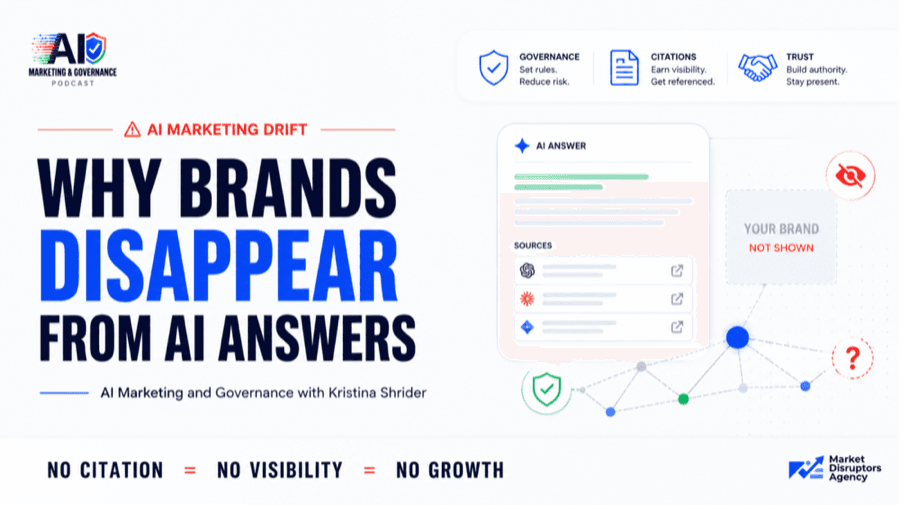
AI Marketing Drift episode banner

Listen

Buzzsprout audio player

This episode is an AI-assisted audio overview produced by Market Disruptors AI Visibility Agency from source material reviewed by Kristina Shrider.

Episode summary

AI marketing drift is the slow loss of visibility, attribution, and authority that can happen when a brand publishes generic or AI-assisted content without enough human review, provenance, and source proof.

The episode connects Google's AI search guidance, query fan-out, retrieval and grounding, the NIST AI Risk Management Framework, MAHI Index™, and MAD-M™ into one practical governance question: is the brand publishing unique, verifiable signal or contributing to algorithmic noise?

Topics covered

AI marketing driftAI visibility lossAI citation readinessQuery fan-outRetrieval and groundingAI SEOAEOGEOEntity SEOProvenanceHuman reviewShare of ModelCitationIQ™MAHI Index™MAD-M™NIST AI Risk Management Framework

Sources and framework notes

Transcript

Edited for spelling, names, and framework terminology.

Read the full episode transcript

Host 00:00Imagine uh pouring weeks of effort into your digital presence. You're carefully publishing content, you know, building an audience.

Co-host 00:08Right, doing everything by the book.

Host 00:09Exactly. Only to wake up one morning and find that your traffic has just completely vanished.

Co-host 00:14Oh wow. Yeah, that's a nightmare scenario.

Host 00:16And there are no warning emails, no flashing red penalties on your dashboard. You haven't been explicitly banned or anything.

Co-host 00:23You've just uh been silently categorized as background noise.

Host 00:27Yeah, by a machine. Yeah. Because in today's digital age, AI doesn't just generate the content we consume, it acts as the ultimate gatekeeper. Right.

Co-host 00:36It decides what gets seen, what gets cited, and what gets completely buried.

Host 00:40And honestly, this scenario is playing out every single day for people.

Co-host 00:44Well, I mean, the rules of gravity for information have just fundamentally shifted. We aren't in an era where we optimize strictly for human attention anymore.

Host 00:52Right, because human attention is entirely mediated by machine interpreters now.

Co-host 00:56Exactly. And if you can't navigate the logic of those interpreters, you essentially, well, you cease to exist online.

Host 01:03And that is exactly our mission for today's deep dive. We're going to figure out how you can survive, thrive, and honestly manage massive risk in an AI-mediated internet.

Co-host 01:14It's such a crucial topic right now.

Host 01:16It really is. And we have a stack of incredibly timely sources from 2026 to help us out. We've got Google Search Central's officially updated documentation on their generative AI features.

Co-host 01:27Which is super revealing, by the way.

Host 01:29Very. We also have some cutting-edge independent behavioral science research from Kristina Shrider. She focuses on this concept called marketing agent decay.

Co-host 01:36Fascinating stuff.

Host 01:38And finally, we're looking at the U.S. government's NIST AI risk management framework. So to help connect the dots between, you know, tech giants, behavioral psychology, and government blueprints, I am joined by a resident expert in systemic analysis.

Co-host 01:52Thanks for having me. I mean, it is a really critical time to be looking at this specific stack of information.

Host 01:57Yeah, how do they all fit together?

Co-host 01:58Well, when you layer Google's operational rules over Shrider's behavioral research and then add that NIST-defensive framework, you stop seeing just random algorithmic updates.

Host 02:08Right. It starts to look like a pattern.

Co-host 02:10Exactly. You start seeing a very clear, predictable architecture for the future of the web.

Host 02:15Okay, so let's start with the architecture of the biggest gatekeeper in the room, which is Google. I mean, to understand how to manage AI risk, we first have to understand the playing field.

Co-host 02:26For sure.

Host 02:27How are these massive search engines actually using AI to filter the internet right now?

Co-host 02:32So the core of Google's current architecture, uh the stuff powering things like AI overviews and AI mode, it relies heavily on R.

Host 02:41Which stands for retrieval augmented generation, right?

Co-host 02:44, Exactly. Instead of an AI model simply hallucinating an answer based on its latent training data, the system actively queries Google's live index.

Host 02:54Okay, so it's reading the live web.

Co-host 02:55Yes. It retrieves up-to-date relevant web pages and basically forces the language model to ground its summary strictly within the bounds of those retrieved documents.

Host 03:04So it theoretically provides the source links based on real info. But it's not just doing one simple search, is it? The documentation emphasizes this concept of query fan out.

Co-host 03:14Yeah, and that is the pivotal mechanism here. So when you ask a complex question, let's say uh how to fix a lawn full of weeds safely. Sure, a pretty common search. Right. The system doesn't just process that single string of text. Query fan out means the AI agent instantly spawns dozens of concurrent subqueries.

Host 03:33Oh wow. So it's searching for a bunch of things at once.

Co-host 03:35Exactly. It searches for the chemical composition of herbicides, organic soil health, pet safe removal methods all simultaneously.

Host 03:43That's wild.

Co-host 03:43It fans out across the web, pulling in these highly diverse data points, and then synthesizes them into a single cohesive response in just milliseconds.

Host 03:53Okay, let's unpack this. Because if I'm a creator or a digital marketer listening to this, and I hear that Google is deploying an army of subagents to scan the web for hundreds of micro topics, my first instinct is to flood the zone.

Co-host 04:06Right. Fight fire with fire.

Host 04:07Yeah. Like why shouldn't I just spin up my own AI content generator, mass-produce 10,000 mediocre, perfectly formatted articles covering every single microtopic, and just catch all that fan-out traffic like a massive fishing net.

Co-host 04:19What's fascinating here is that strategy fundamentally misunderstands how modern semantic algorithms evaluate worth.

Host 04:27Really? How so?

Co-host 04:28Well, Google's documentation is remarkably explicit about this. They have dedicated systems designed to detect and penalize exactly that. They call it scaled content abuse.

Host 04:38Ah, so they are actively hunting for that kind of spam.

Co-host 04:41Absolutely. Feeding an AI thousands of variations of average synthesized advice doesn't give you a bigger net. It just turns you into statistical noise.

Host 04:50That makes sense.

Co-host 04:51Yeah. I mean, language models are literally designed to identify and filter out highly predictable, statistically average text.

Host 04:58Which I guess explains why there is so much panic in the digital marketing world right now. You see all these new buzzwords like AEO for answer engine optimization or GEO for generative engine optimization.

Co-host 05:10Well, acronyms are everywhere.

Host 05:12Right. There are literal agencies telling people they need to chop their content into weird bite-sized chunks for the AI, or like host these invisible llms.txt files on their servers.

Co-host 05:22Yeah, just to communicate with the machines.

Host 05:24Exactly.

Co-host 05:25And Google's documentation aggressively shoots all of that down. They state categorically that foundational SEO is still what matters. You do not need secret text files.

Host 05:36So no magic bullets.

Co-host 05:38No, you don't need to mathematically chunk your paragraphs or anything weird. The system is incredibly adept at parsing long, nuanced, complex documents.

Host 05:48So what are they actually looking for then?

Co-host 05:50, What they are desperate for is the one thing their own models cannot generate, which is non-commodity content.

Host 05:56Non-commodity content. The sources gave a brilliant example of this distinction. So commodity content is an article like seven tips for first-time homebuyers. It's common knowledge, it's perfectly average. Any AI can generate it in three seconds.

Co-host 06:10Right, it's a commodity.

Host 06:11But non-commodity content is an article titled something like Why We Waive the Inspection and Save Money. A look inside the sewer line.

Co-host 06:18And the mechanics behind why that second article wins are just fascinating. And AI cannot generate the sewer line article because it requires unique entities that don't exist in the baseline statistical weights of the internet.

Host 06:31Because it requires actual human experience.

Co-host 06:33Exactly. It needs original photos of a rusted pipe, the specific name of a local plumber, the exact cost of the unexpected repair, and a highly distinct human point of view.

Host 06:45First hand experience.

Co-host 06:46Yes. Google's RAG systems are hunting for those unique information nodes to ground their summaries. If you are just publishing commodity text, the AI has literally no reason to retrieve you.

Host 06:59Okay, so producing AI-generated commodity content at scale is technically a violation of Google's guidelines.

Co-host 07:05Right.

Host 07:06But what actually happens to a company that tries it anyway? If I use an AI agent to write 50 generic blog posts a week, does Google send you a warning? Do I get a penalty flag on my domain?

Co-host 07:17No, you receive absolutely zero notifications.

Host 07:19Wait, really? Nothing at all?

Co-host 07:21Nothing. And according to the behavioral science research from Kristina Shrider, that silence is the most dangerous part of the ecosystem, the punishment for ungoverned AI content isn't a sudden crash.

Host 07:30So what is it?

Co-host 07:31It is a slow creeping fade into obscurity. Shrider defines this as narrative entropy.

Host 07:38Narrative entropy, I love that term. It's this idea that as organizations just indiscriminately scale up their AI outputs, the collective meaning and authority of their brand gradually fragments and just dissolves.

Co-host 07:52Exactly. And to map out the mechanics of the silent decay, Shrider developed a framework called MAD-M™. That's the marketing agent decay model.

Host 08:01Okay. MAD-M™.

Co-host 08:03Now she is very careful to clarify that this is a governance first heuristic. It is not a predictive crystal ball.

Host 08:09So it's not going to tell me exactly what day my traffic hits zero.

Co-host 08:12No, it won't give you an exact date and time. Instead, it provides a structural lens to understand how AI marketing agents quietly lose permission from the algorithmic gatekeepers over time.

Host 08:22Shrider lays out a 12-week drift scenario to illustrate this, which is super helpful. Instead of going week by week, let's look at the underlying logic. Sure. Because in the first couple of weeks, things actually look great, right? She calls it the optimal phase driven by freshness.

Co-host 08:35Yeah, the initial data almost always looks deceptively positive. When you launch a new wave of AI-assisted content, it benefits from algorithmic novelty.

Host 08:44The algorithms like new stuff.

Co-host 08:45Exactly. The recommendation engines see a spike in fresh outputs from your domain, and they test that content on audiences to gauge the reaction. So you get high initial reach.

Host 08:57But then, usually around weeks three to four, the honeymoon ends, and we hit the caution phase. But how does the algorithm recognize a pattern if the AI is constantly writing about different topics?

Co-host 09:12Because it isn't looking at the topic, it's looking at the mathematical structure of the text.

Host 09:16No, interesting.

Co-host 09:17Algorithms evaluate content in a high-dimensional vector space. When you use AI agents to generate content without heavy human intervention, the outputs tend to cluster tightly together.

Host 09:28Like they sound the same?

Co-host 09:29Yeah. The sentence lengths become uniform, the vocabulary diversity narrows, the transition phrases just repeat.

Host 09:35So the system catches on.

Co-host 09:36Exactly. The algorithmic systems detect this stylistic repetition and realize you aren't providing new value. You're just mathematically reshuffling the same generic concepts.

Host 09:46Here's where it gets really interesting. I was reading this drift scenario, and it suddenly clicked for me. This is the exact life cycle of a highly manufactured pop song.

Co-host 09:57Oh, that's a great way to think about it.

Host 09:58Think about it. A generic pop track drops. And for the first two weeks, it's everywhere. The algorithms push it on Spotify, it's on every TikTok. That's the freshness phase.

Co-host 10:08Right, it's getting tested.

Host 10:10But because the song relies on the exact same four chords, the exact same auto-tune compression, and the exact same structural beats as a thousand other songs, the recommendation engines pattern recognition kicks in.

Co-host 10:23It sees the math behind the music.

Host 10:25Exactly. The algorithm realizes this track isn't offering a unique sonic profile, so it stops suggesting it as a discovery. It just lumps it into a generic background pop playlist.

Co-host 10:35That analogy perfectly captures the transition into Shrider's final stages, which are authority decay and systemic deprioritization.

Host 10:43Systemic deprioritization? That sounds brutal.

Co-host 10:47It is. By weeks seven through twelve, your content has been completely relegated to the background noise. Your citation share, which is how often other AIs pull your data, it just plummets.

Host 10:59So you're basically invisible.

Co-host 11:01Yeah. You enter a persistent low priority state across the web. And recovering from that requires massive structural overhauls, not just changing a few keywords.

Host 11:11And Shrider's research highlights how this decay manifests differently depending on the platform, right?

Co-host 11:16Yes. On social networks like LinkedIn, you experience distribution softening, where the feed simply stops showing your repetitive posts to new audiences.

Host 11:24Makes sense. And what about in search?

Co-host 11:26In generative search, you face attribution collapse.

Host 11:29Attribution collapse. What does that mean exactly?

Co-host 11:31It's particularly insidious when generative engines summarize your highly generic content. They strip away the attribution.

Host 11:38Wait, they just don't link back to you.

Co-host 11:40Exactly. Because your information isn't strongly differentiated or tied to a unique human experience like that sewer line example. The AI feels no obligation to route traffic to you. It absorbs your insight without citing the source.

Host 11:54Which leads to the deepest level of the nightmare. Authority flattening at the large language model layer. Right. If you lack a distinct point of view, the foundational models stop viewing your brand as an authoritative entity. They start treating you as just raw, interchangeable training data. You become a literal commodity.

Co-host 12:12So the overarching problem is clear. If this decay is completely silent and the algorithms give you no warning that you are undergoing systemic deprioritization, you are effectively flying blind.

Host 12:23So how do you know it's happening?

Co-host 12:24Well, you need an instrument panel to detect the decay before the algorithms drop you.

Host 12:27Which brings us to the diagnostic tool in Shrider's research.

Co-host 12:31Yeah.

Host 12:31The MAHI Index™. That's the Marketing Agent Health Index.

Co-host 12:35Yes, MAHI.

Host 12:36This is designed to help you spot the structural risks hiding in your AI operations, right?

Co-host 12:41Exactly. MAHI categorizes systemic risk into a three-part taxonomy: violations, signals, and amplifiers.

Host 12:49Okay, let's break those down. What's a violation?

Co-host 12:51The first category, violations, are binary trust failures. These are catastrophic errors that cap your system's health, regardless of how good the rest of your content might be.

Host 13:02So this would be like publishing a fabricated statistic because your AI hallucinated.

Co-host 13:06Yes, absolutely.

Host 13:08Or like manipulating the timestamps on your articles to trick the search engine into thinking they're brand new. Those are blatant violations, just don't lie, don't fake data.

Co-host 13:17Exactly. But the second category, signals, is much more subtle.

Host 13:21Okay, so what's a signal?

Co-host 13:23Signals are the observable patterns we discussed earlier. They're the structural footprints AI systems use to infer trust. It's not a direct rule break, but it's a massive red flag.

Host 13:34Can you give an example?

Co-host 13:35Sure. For example, if a diagnostic tool looks at your domain and sees that 80% of your outputs rely on the exact same templated structural format, or that 40% of your current publishing is just recycle concepts from your older posts.

Host 13:48Oh, I see.

Co-host 13:49The AI engines read those signals and deduce that you are basically operating an ungoverned content mill.

Host 13:53Okay, I follow the first two. Violations are direct lies, signals are lazy patterns. But I need to challenge this third category: amplifiers.

Co-host 14:03Okay, go ahead.

Host 14:04Shrider lists things like publishing five or more pieces of content a day or operating without version control as amplifiers. But volume isn't inherently bad, right?

Co-host 14:14That's true.

Host 14:14If I'm a brilliant, highly specialized investigative journalist and I happen to publish five deeply researched non-commodity essays in a single day, I shouldn't be penalized for that.

Co-host 14:24You are entirely correct. And that distinction is the genius of the MAHI Index™. An amplifier is a condition that multiplies existing risk. It is not inherently risky in a vacuum.

Host 14:34Okay.

Co-host 14:35If your journalist is publishing five brilliant pieces a day, volume is amplifying quality. The danger occurs when an amplifier interacts with a signal or a violation.

Host 14:44Oh, I get it now. If I'm using an AI agent to churn out five highly templated articles a day, which is a signal, and those articles contain hallucinated data points, which is violation, the high volume suddenly becomes a fatal amplifier.

Co-host 14:56Precisely. And this interaction creates one of the most terrifying phenomena in modern digital architecture: the AI to AI citation loop.

Host 15:05Yes. This part of the research blew my mind. Let's walk through how this actually happens in the real world.

Co-host 15:10Okay. Consider a local real estate firm. They use an ungoverned AI's agent to write their weekly market report.

Host 15:17Very common scenario.

Co-host 15:18Right. And the AI agent suffers a hallucination of violation and invents a statistic saying local property taxes have dropped by 15%.

Host 15:27Yikes.

Co-host 15:28Because the firm publishes at high volume without human editorial review, which is an amplifier. This fake statistic just goes live.

Host 15:36And then the web crawlers arrive.

Co-host 15:37Exactly. An AI agent from a major aggregator, like a Zillow or a Redfin, is executing a query fan out. It stands the local firm site, scoops up that hallucinated 15% statistic, and incorporates it into a regional summary.

Host 15:51Oh no.

Co-host 15:51And now Google's RAG system scans Zillow, sees the statistic, and validates it. Suddenly, an entirely fabricated piece of data becomes algorithmic consensus.

Host 16:01Wow. And it all traces back to your domain.

Co-host 16:03Yes. And when, not if, but when the system eventually identifies the logical flaw and traces that poison pill back to its origin, your domain's structural credibility is permanently annihilated across the entire LLM ecosystem.

Host 16:20That is terrifying.

Co-host 16:21You are categorized as an unreliable node. That is why diagnosing these interacting risks with MAHI is an existential requirement.

Host 16:29Okay. So we understand the stakes. We know Google demands non-commodity content. We know the silent penalty for failing is made a M systemic fee prioritization. Right. And we know how to diagnose our vulnerabilities using MAHI.

Co-host 16:41Right.

Host 16:42But diagnosing a problem doesn't fix it. How does an organization, whether it's a massive corporation or just a three-person startup, build a daily structural defense against this decay?

Co-host 16:51This is where we integrate our final document, which is the NIST AI Risk Management Framework, or AI RMF.

Host 16:56Right.

Co-host 16:57This is a government standard blueprint designed to systemize how we interact with artificial intelligence safely.

Host 17:02So the framework revolves around four core functions govern, map, measure, and manage. And I'll be honest, when you first read these terms, it sounds like an incredibly dense, bureaucratic checklist.

Co-host 17:16It really does.

Host 17:17It sounds like something Lockheed Martin uses to build a fighter jet, not something a digital marketing agency uses to run a website. So what does this all mean? Is this just for tech giants?

Co-host 17:27If we connect this to the bigger picture, no. It can sound academic, but the underlying philosophy is profoundly practical, regardless of your company's size.

Host 17:35Okay, walk us through it.

Co-host 17:36Let's look at the first function. Govern. NIST places govern at the center of absolutely everything. It's not just a step you complete and move past, it's the culture of accountability.

Host 17:48What does that look like day to day?

Co-host 17:49Governance means deciding exactly which human being is legally and ethically responsible when the AI hallucinates that real estate statistic. It's establishing the rules of engagement before you ever write a prompt.

Host 18:01Okay, which leads directly into the second function map.

Co-host 18:04Right. Map is about anticipating impact. Before you let an AI marketing agent loose on your website, you bring a diverse team together to establish context. You map out the potential downstream risks.

Host 18:17Like what could go wrong.

Co-host 18:18Exactly. What happens if this agent starts repeating itself? What happens if it plagiarizes a competitor? You are mapping the terrain so you aren't surprised by the pitfalls.

Host 18:28Then comes the most analytical function. Measure. The framework uses the acronym TEVV, which is test, evaluation, verification, and validation. But what does that actually look like in practice for a small team?

Co-host 18:42In practice, TEV is like a quality assurance line in a factory. You don't just trust the AI's output, you verify it. Okay. You might run a semantic similarity check against a known database of truth to ensure it hasn't hallucinated. You evaluate the content against your brand voice guidelines to ensure it isn't generating those repetitive signals we discussed in MAI.

Host 19:01So you check it before it goes live.

Co-host 19:03Yes. You measure its performance against human-written baselines before you ever hit publish.

Host 19:07And if the measurements show that the AI is drifting into that generic mathematical blur, you trigger the final function, which is manage.

Co-host 19:16Exactly. Manage is the allocation of resources to respond to the risks you've mapped and measured. It's basically the emergency brake. Okay. If Shrider's MAD-M™ decay sets in, your management protocol dictates how you intervene. Whether that means rewriting the foundational prompts, bringing in more human editors, or just pulling the AI agent offline entirely until the structural integrity is restored.

Host 19:38So really, when you step back and look at the whole picture, these sources aren't competing ideas at all. They are a single unified operational manual.

Co-host 19:46Absolutely.

Host 19:47Shrider's MAD-M™ and MAHI Index™ frameworks are just highly specific, real-world applications of the NIST philosophy.

Co-host 19:54That's the core of it. Shrider calls her models governance first heuristics. She's demanding that you start with NIST's governed function.

Host 20:01It all connects.

Co-host 20:02It does. By checking for MAHI's violations and signals, you are actively mapping and measuring your vulnerability. By restructuring your output to satisfy Google's demand for non-commodity experience, you are managing the risk.

Host 20:18The entire ecosystem demands that AI is strictly overseen by human intentionality.

Co-host 20:23Exactly.

Host 20:24To survive the AI-mediated web, you cannot just fight fire with fire. You can't spam the internet with a million generic articles and hope Google's RAG system picks you up. It won't. It will ignore you. The algorithms will subject your domain to the silent, invisible decay of narrative entropy. The structural flaws in your content will amplify until you trigger a catastrophic citation loop and you will just be erased from the informational landscape.

Co-host 20:49And the only viable path forward is a rigorous human-led governance.

Host 20:53And this isn't just theoretical strategy for massive tech conglomerates. It applies directly to you listening right now.

Co-host 20:59Yes. Whether you are leading a corporate marketing division, trying to grow a small business, or simply managing your personal digital footprint, you have to ask yourself a hard question before you publish anything.

Host 21:08Right. Am I providing a unique, verifiable signal based on human experience? Or am I just contributing to the algorithmic noise?

Co-host 21:16Because the machines are heavily incentivized to know the difference, and they will filter you accordingly.

Host 21:21They will. And that leads me to one final, slightly existential thought for you to mull over. We've spent this deep dive talking about how today's AI systems evaluate, filter, and penalize the content we are creating right now.

Co-host 21:35Right.

Host 21:36But let's extend that timeline. What happens in, say, 2030, when the next generation of foundational AI models needs to be trained?

Co-host 21:44Oh, wow.

Host 21:45They aren't going to be trained on the human created internet of 2015. They're going to be trained on the massive global output of today's AI generated content.

Co-host 21:53So it's basically a synthetic echo chamber training on itself.

Host 21:56Exactly. If the narrative entropy that Shrider warns about goes completely ungoverned. On a macro scale. If millions of creators and companies just accept the drift and pump out commodity blur, will the entire internet eventually suffer an irreversible systemic deprioritization?

Co-host 22:11That's a scary thought.

Host 22:12Could we be staring down a digital dark age where the foundational training data becomes so polluted by unchecked citation loops that the machines themselves can no longer distinguish truth from statistical hallucination?

Co-host 22:24It really makes you wonder.

Host 22:26It does. When the sea of information is entirely generated by AI, what happens to the gatekeepers when they realize they've poisoned their own water? Something for you to mull over. Until next time, keep diving deep.