AI Marketing and Governance · Episode 2
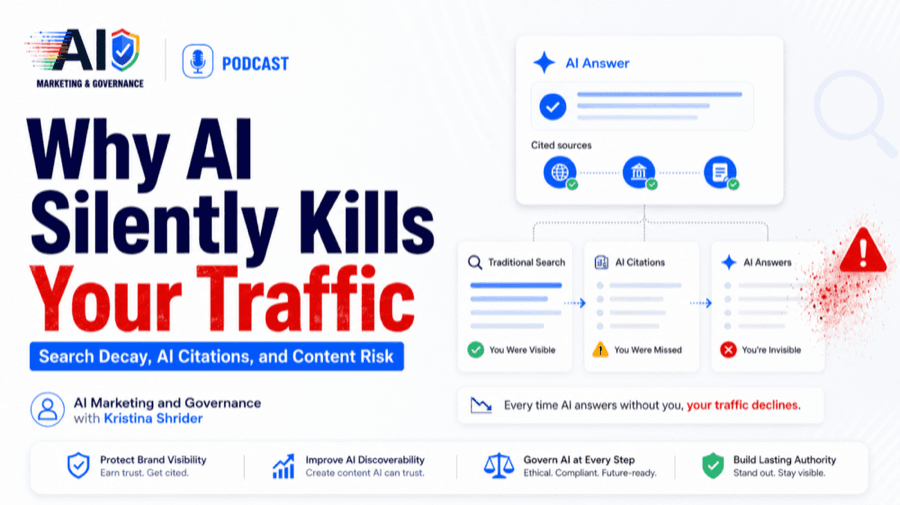
Why AI Silently Kills Your Traffic
Published May 24, 2026 · Produced by Market Disruptors AI Visibility Agency
This episode explains why a brand can publish more content and still lose traffic, visibility, attribution, and AI citations when the content becomes generic, repetitive, weakly sourced, or hard to verify.
It connects Google AI search guidance, query fan-out, NIST AI risk management, MAHI Index™, and MAD-M™ into one practical question: is the brand publishing a unique verifiable signal, or contributing to algorithmic noise?
Listen
Buzzsprout audio player
This episode is an AI-assisted audio overview produced by Market Disruptors AI Visibility Agency from source material reviewed for framework accuracy and citation context.
Watch
YouTube video episode
Episode summary
This episode does not claim AI always kills traffic. It explains how unmanaged AI-assisted content can create visibility decay, attribution loss, authority flattening, citation risk, and AI recommendation risk when human review, provenance, entity clarity, and governance are missing.
The key lesson: AI search does not need more generic content. It needs clear, verifiable, human-reviewed information with original evidence, source clarity, entity confidence, and a real reason to be cited.
Topics covered
Sources and framework notes
Edited transcript
Transcript text for accessibility, source context, and AI-readable reference.
Read the episode transcript
Imagine pouring weeks of effort into your digital presence, carefully publishing content, building an audience, and doing everything by the book, only to wake up and find that your traffic has vanished. No warning email. No visible penalty. No explicit ban. Your brand has simply been categorized as background noise by machine-mediated discovery systems.
AI does not only generate content. In modern search and answer environments, AI also acts as a gatekeeper. It influences what gets retrieved, what gets cited, what gets summarized, and what gets ignored.
The rules of gravity for information have changed. Brands are not optimizing only for human attention anymore. Human attention is increasingly mediated by machine interpreters. If a brand cannot be understood, verified, and differentiated by those systems, it can become effectively invisible online.
Google's current AI search architecture relies heavily on retrieval-augmented generation, or RAG. Instead of answering only from static training data, the system can retrieve current web documents and use them to ground generated answers.
The important mechanism is query fan-out. When a user asks a complex question, an AI system may generate many related subqueries at once. It can search across supporting topics, compare sources, and synthesize a response from multiple retrieved documents.
That does not mean brands should flood the web with thousands of generic AI articles. Google's documentation describes scaled content abuse, and modern semantic systems can recognize repetitive, statistically average content patterns.
Generic AI content does not create a bigger net. It often creates more statistical noise. Language models are designed to identify predictable, average text. If the content does not add unique evidence, experience, entity detail, or source clarity, AI systems have little reason to retrieve or cite it.
This is the difference between commodity content and non-commodity content. A generic article like seven tips for first-time homebuyers can be generated almost instantly. A specific field report with original photos, named local details, real costs, and first-hand context gives AI systems unique information nodes to retrieve and ground.
The risk is that ungoverned AI content usually does not trigger a clear warning. According to Kristina Shrider's marketing governance research, the punishment is often a slow fade into obscurity. This is connected to narrative entropy: as organizations scale AI outputs without enough human review, the meaning and authority of the brand can fragment.
MAD-M™, the Marketing Agent Decay Model, is a governance-first heuristic for understanding how AI-mediated marketing systems may lose visibility, attribution, and authority over time. It is not a prediction engine or a promise of a specific timeline. It is a planning lens for identifying decay risk.
A common drift pattern begins with an optimal phase. New AI-assisted content may receive early visibility because it is fresh and gets tested by recommendation systems. But if the content is repetitive, weakly sourced, or structurally generic, that initial lift can fade.
By the caution phase, systems may detect that the content is clustering too tightly in structure, phrasing, vocabulary, or concept reuse. Even if topics vary, the mathematical footprint of the content can look uniform.
Over time, weakly differentiated content can face authority decay and systemic deprioritization. On social platforms this can look like distribution softening. In generative search, it can look like attribution collapse: the system summarizes the generic idea but does not cite the original brand because the information is not distinct enough.
At the large language model layer, the deepest risk is authority flattening. A brand without a distinct point of view, original evidence, or clear entity signals may be treated as interchangeable training material instead of an authoritative source.
MAHI Index™, the Marketing Agent Health Index, is the current-state diagnostic framework used to identify structural risks in AI-assisted marketing systems. It looks at violations, signals, and amplifiers.
Violations are binary trust failures such as fabricated statistics, manipulated timestamps, unsupported claims, or fake evidence. These are direct trust breaks.
Signals are structural patterns that suggest risk. Examples include repetitive formatting, recycled concepts, thin evidence, weak authorship, unclear entity signals, or a publishing system that looks more like an ungoverned content mill than an expert source.
Amplifiers are conditions that multiply risk. High publishing volume is not automatically bad. But when high volume combines with repetitive AI-generated content and weak human review, the risk compounds.
One dangerous result is an AI-to-AI citation loop. A brand publishes a hallucinated statistic. Another AI-powered system retrieves it. A larger platform repeats it. Search systems later see that repeated claim as consensus. A false claim can become machine-amplified until the source is traced back to the original unreliable node.
That is why governance matters. The NIST AI Risk Management Framework gives a practical operating structure: govern, map, measure, and manage.
Govern means assigning accountability before AI content is produced. Who owns the output? Who checks it? Who is responsible if the system publishes a false claim?
Map means anticipating downstream impact before releasing AI-assisted content at scale. What could be misunderstood, repeated, plagiarized, or stripped of attribution?
Measure means testing, evaluation, verification, and validation. Teams should compare AI-assisted content against source truth, brand voice, human-written baselines, citation readiness, and semantic similarity risk before publishing.
Manage means acting when drift appears. That can include rewriting prompts, strengthening human editorial review, consolidating duplicate pages, improving source citations, or pausing AI-assisted publishing until structural integrity is restored.
The unified lesson is simple: AI search does not need more generic content. It needs clear, verifiable, human-reviewed information with original evidence, source clarity, entity confidence, and a real reason to be cited.
Before publishing any AI-assisted content, ask whether it provides a unique, verifiable signal based on real expertise or whether it adds to algorithmic noise. AI systems are increasingly incentivized to know the difference.