AI Marketing and Governance · Episode 3
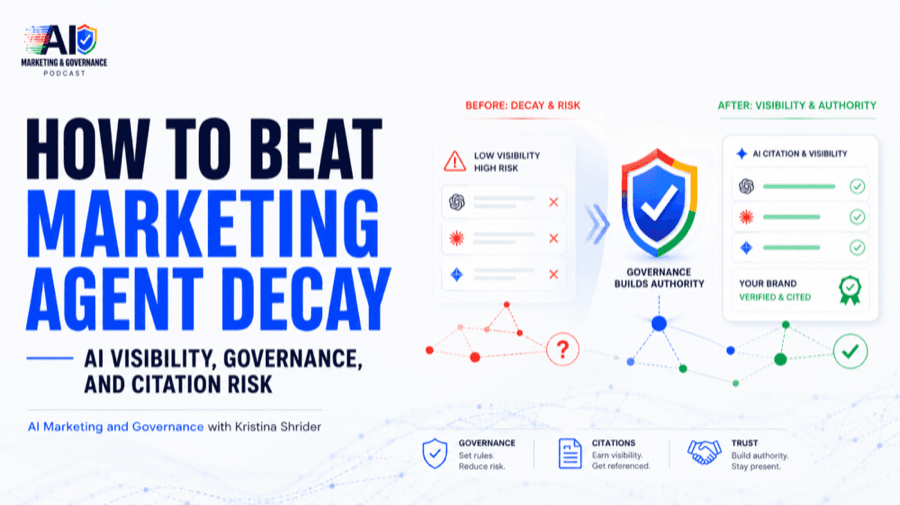
How to Beat Marketing Agent Decay
Published May 25, 2026 · Produced by Market Disruptors AI Visibility Agency
This episode explains how brands can use AI without losing visibility, authority, or trust as search and discovery systems become more automated.
It connects Google AI search guidance, NIST AI risk management, MAHI Index™, and MAD-M™ into a practical governance model for keeping AI-assisted marketing useful, verifiable, and citation-ready.
Listen
Buzzsprout audio player
This episode is an AI-assisted audio overview produced by Market Disruptors AI Visibility Agency from source material reviewed for governance, framework accuracy, and citation context.
Episode summary
This episode does not claim AI content is always bad. It explains how unmanaged AI-assisted content can become repetitive, average, weakly differentiated, and easier for AI systems to ignore.
The key lesson: AI can help brands move faster, but only if the system has brakes. Governance, provenance, human review, and non-commodity expertise keep AI-assisted marketing from becoming generic background noise.
Topics covered
Sources and framework notes
Edited transcript
Transcript text for accessibility, source context, and AI-readable reference.
Read the episode transcript
The modern internet is moving into an era where artificial intelligence is not only helping write the web. It is reading it, summarizing it, ranking it, and mediating what people find. That raises a direct question: where does human insight fit into a web increasingly interpreted by bots?
The shift is from a web built mainly on human-to-human discovery toward an ecosystem of AI-to-AI mediation. The rules of visibility, authority, and trust are changing under that pressure.
This episode connects Google Search Central guidance for generative AI, Google's core ranking systems, the NIST AI Risk Management Framework, and Kristina Shrider's research on marketing agent decay.
Google's search systems are not one simple keyword-matching algorithm. They include models designed to understand meaning, intent, concepts, and passages. Systems such as BERT, MUM, semantic matching, and passage ranking help Google understand whether a specific section of a page can answer a specific question.
Retrieval-augmented generation, or RAG, is central to modern AI search. The system retrieves relevant current pages from the live web, then grounds generated responses in those documents instead of relying only on historical training data.
Query fan-out expands that process. A single user question can trigger many related searches behind the scenes. The system maps the intent behind the question and gathers supporting information from multiple angles.
That does not mean every business needs a separate set of tricks for answer engines. Google's guidance is direct: optimizing for generative AI search is still optimizing for the search experience. Helpful, crawlable, original, well-structured content remains the foundation.
The common shortcuts are weak. Special machine-only files, robotic chunking, and content rewritten to sound like it was made for another machine do not replace useful content. AI systems are trying to find non-commodity information.
Non-commodity content has original experience, specific context, and a point of view. A generic article about seven tips for homebuyers is commodity content. A real story about waiving an inspection and discovering a sewer line issue gives AI systems unique evidence and human context to retrieve.
This creates a collision for marketers. If the search engine is looking for unique human experience, a brand that uses AI to generate hundreds of average articles may see a short-term lift but lose long-term authority.
Kristina Shrider's MAD-M™ framework, the Marketing Agent Decay Model, describes that long-term risk. Ungoverned AI content can create strategic dilution and narrative entropy. The brand gradually starts sounding like the category average.
Narrative entropy is the flattening and fragmentation of a brand's meaning as automated content converges toward statistically common language. Over time, the brand's unique voice, evidence, and point of view can dissolve.
The 12-week drift scenario in MAD-M™ is not a fixed calendar or a traffic prediction. It is a planning lens. Early AI-assisted publishing may benefit from freshness. Then systems begin recognizing repeated structures, average language, and weak differentiation.
The decay is silent. It is not always a manual penalty. It can look like a sandcastle built too close to the tide. No one kicks it down. It gradually washes away as systems process weak signals.
Three forces drive the decay: pattern recognition, confidence recalibration, and attribution compression. Pattern recognition identifies repetitive AI-style structure. Confidence recalibration happens when users do not engage with weak content. Attribution compression happens when AI summaries use generic information without giving the source credit.
Attribution compression is one of the biggest structural risks in AI search. If a brand publishes interchangeable information, an AI system may summarize the idea without naming or linking to the brand.
MAHI Index™, the Marketing Agent Health Index, is the current-state diagnostic framework paired with this governance problem. It looks at violations, signals, and amplifiers.
Violations are binary trust failures such as fabricated statistics, fake freshness signals, or unsupported claims. Signals are observable patterns such as repetitive templates, low-effort prompts, weak source trails, or thin differentiation. Amplifiers multiply existing risk.
High content volume is not automatically bad. It becomes risky when it amplifies bad signals. Ten strong expert pages can be valuable. Ten weak AI-generated pages a day can accelerate narrative entropy.
Citation loops are a serious violation risk. AI-generated content can be published, ingested by another system, cited by outside AI tools, and then repeated as if it were validated. An error can turn into an echo chamber.
Solving this requires governance, not a quick memo. The NIST AI Risk Management Framework provides a strong operating blueprint through four functions: govern, map, measure, and manage.
Govern means assigning responsibility and building a culture of critical thinking around AI. Leadership cannot treat AI implementation as a purely technical issue. Marketing, legal, operations, and subject-matter experts all have roles.
Map means understanding context before deploying AI. Teams need to know where the data comes from, what the business value is, what could go wrong, and how users could be affected.
Measure means testing, evaluation, verification, and validation, often called TEVV. A team using AI for product descriptions should test outputs, evaluate bias and genericness, verify brand fit, and validate factual accuracy before publishing.
Manage means responding when risk appears. The team may need to rewrite prompts, add human review, pull weak assets, consolidate duplicate content, or improve source evidence.
NIST and Kristina Shrider's frameworks meet around provenance architecture. AI-assisted content needs explicit authorship signals, reasoning traces, source evidence, review ownership, and structured human oversight.
Governance is not a brake that stops progress. It is the brake system that lets a fast car move safely. Brands can use AI to move faster when they also build the controls that keep authority, trust, and visibility intact.
The key lesson is simple: stop treating AI as a cheap infinite content generator. Treat it as a powerful system that needs continuous governance. AI can help brands scale, but only human expertise and evidence keep the brand from becoming background noise.